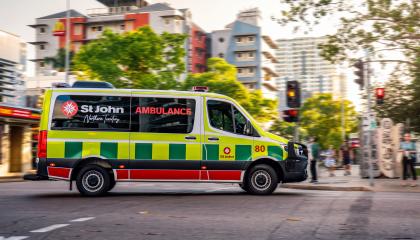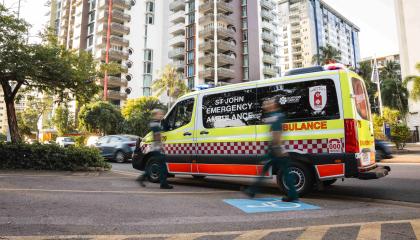
St John NT 2026 ICP Pathway cohort, pictured (L to R):
James Rowland, Dylan Denmead, Fergus O'Gallagher, Joshua Everingham, David Clarke, Justin Houben, Rebecca Muir, and Sam Immens.
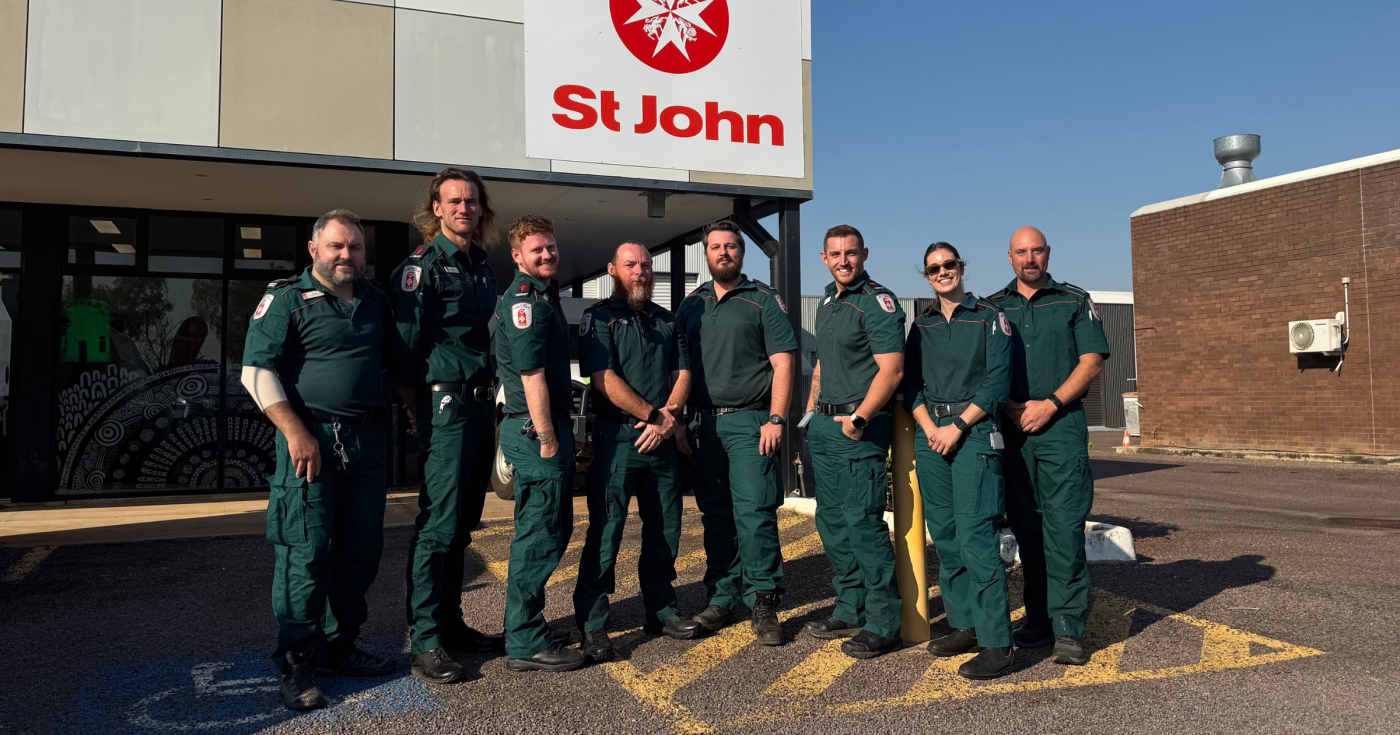
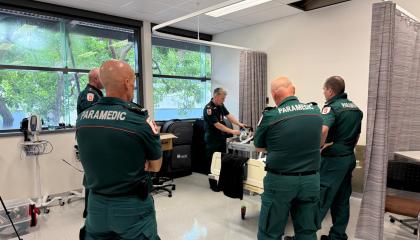
Six experienced St John NT paramedics have commenced an intensive six-week training program in Darwin today, marking the next step in building advanced paramedic capability across the Northern Territory.
Developed with support from NSW Ambulance, the six-week intensive marks the commencement of St John NT’s new two-year Intensive Care Paramedic Training Pathway, specially designed to strengthen the care available to critically ill and injured patients across urban, regional and remote communities in the Territory.
The first cohort brings together paramedics from across the NT:
- David Clarke, Katherine
- Dylan Denmead, Tennant Creek
- Joshua Everingham, Katherine
- Fergus O'Gallagher, Darwin
- Justin Houben, Alice Springs
- Rebecca Muir, Darwin
St John NT Deputy Medical Director Dr David Monks said the pathway would prepare the organisation’s experienced paramedics to provide a higher level of care in complex and time-critical emergencies.
“Across the Territory, Intensive Care Paramedics care for critically ill and injured patients a long way from hospital and support resources, often in challenging environments and with limited immediate support,” Dr Monks said.
“This pathway is designed to build the advanced clinical knowledge, practical skills and decision-making needed to manage those patients safely from the first point of care through to hospital or retrieval.”
Beginning on Monday 27 July, the intensive program will cover advanced resuscitation, cardiac care, trauma, paediatric and obstetric emergencies, airway management, mechanical ventilation, remote care and clinical leadership.
The program is supported and overseen by St John NT’s Patient Safety and Quality and Clinical Services teams, which ensure the training, assessment and clinical governance requirements are completed to the required standard.
The course will move from foundational assessment and practical skills into increasingly complex simulations designed to reflect the conditions paramedics may face across the Territory.
Participants will undertake a week of operational simulation training alongside emergency and specialist agencies, including exercises involving vertical rescue, road crash rescue, water operations, complex extrication and aeromedical retrieval. (Details and media opportunities will be shared closer to the date.)
Dr Monks said the program would focus not only on advanced procedures, but also on the judgement required to use them appropriately.
“Intensive care practice is not simply about performing more advanced interventions,” he said.
“It requires clinicians to assess risk, make complex decisions under pressure and adapt their care to the patient, the environment and the resources available.
“The practical and simulation-based components of the course will give participants the opportunity to develop those skills in realistic and increasingly demanding scenarios.”
The final week will focus on practical and theory assessments, identifying areas for further development and preparing participants to transition into supervised clinical practice.
The pathway is being supported by NSW Ambulance through the expertise of Critical Care Paramedic and educator Sam Immens, who has more than 25 years' experience as a paramedic and has led the design of the education program.
In addition to developing the curriculum, Mr Immens will continue to provide mentorship and educational support to participants as they progress through the pathway, drawing on NSW Ambulance's extensive experience in intensive care paramedic education and clinical governance.
St John NT Director Ambulance Services Sam Kellick said the pathway would build on the capability of the organisation’s existing ICPs while drawing on the support of a larger ambulance jurisdiction.
“Our current ICPs bring significant experience, clinical leadership and a deep understanding of what advanced care looks like in the Territory,” Mr Kellick said.
“They will play a central role in supporting and mentoring this first cohort as participants move from intensive education into supervised practice.
“We are grateful for the support of NSW Ambulance. As a larger jurisdiction, they bring access to established education resources, specialist expertise and broader clinical networks that complement the capability already within St John NT.
“Together, that gives our trainees the benefit of strong local mentorship, backed by the experience and resources of one of Australia’s largest ambulance services.”
Following the intensive program, participants will continue through supervised clinical practice, mentoring and assessment, developing into some of Australia’s most capable Intensive Care Paramedics.
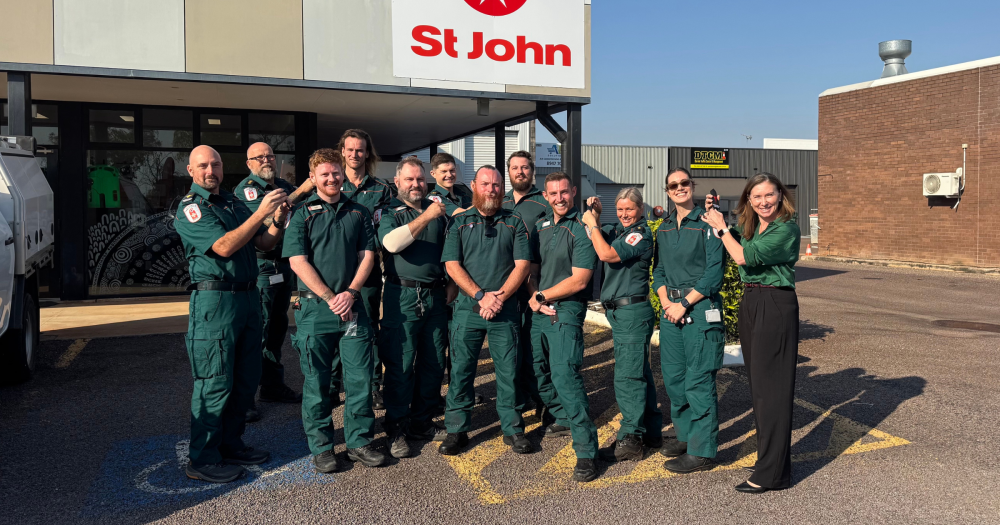
St John NT 2026 ICP Pathway cohort receiving their ICP Intern epaulettes.